
Community Pulse Team: Report Out
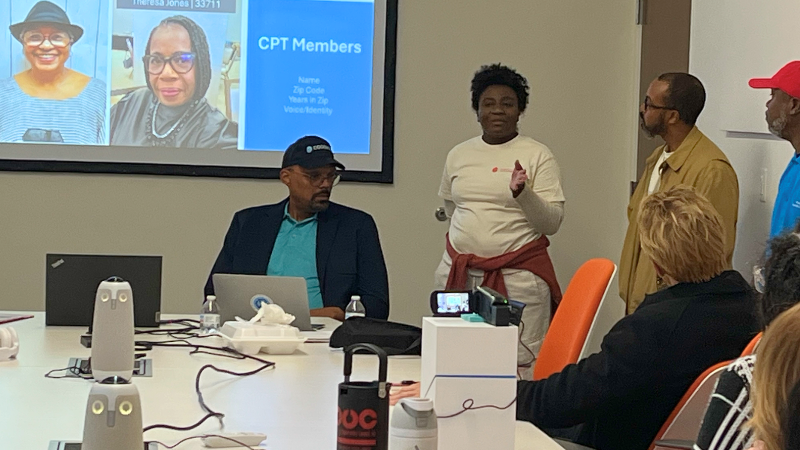
For the past year, the resident researchers of the Foundation’s Community Pulse Team (CPT) have been working on qualitative research on mental health and wellness in the three zip codes of the South St. Pete Community Redevelopment Area. Earlier this year, they presented their research findings to a group of funded partners. They introduced their research questions, training, and approach, and then spoke to nonprofit leaders gathered about trends they had noticed through their research in the South St. Pete community.
The talked about barriers to seeking care – like stigmas, mistrust, and accessibility. They discussed the varying ways people understand mental health and shifting definitions across generations. They also talked about the need for culturally responsive care – and the hope many people feel despite challenges, believing that attainable solutions are possible when resident voice is incorporated.
“Before, my neighbors were faces in the street, they were anonymous people and I assumed what their intentions were. Because of the Community Pulse Team, I had an incentive to go out and actually meet them. I got to know their names, hear their stories of resilience and reflections on the challenges we face every day in our neighborhood,” CPT member Brian Peret said. “Every single person I’ve met has an idea of help for them. Each and every person defines health uniquely for themselves. Each and every person I met wants to be healthy and is willing to reach outside to find that help.”
From June 2024 to May 2025, the Foundation’s Dr. Susie Paterson and Dr. Stephanie Rosado trained CPT members in participatory research and evaluation methods. Then, the seven CPT members, who represent the zip codes of the South St. Pete CRA, crafted research questions focusing on mental health and wellness, which was a 2023 and 2024 Foundation funding priority, and went out into their neighborhoods to conduct qualitative interviews.
“I did interviews with people that I know. But just because I knew them, it didn’t mean we had ever had deep conversations about mental health before. CPT gave me a chance to have those conversations and then share what my friends were going through and how they persevered,” said CPT member Sema’j Stubbins. “We got past the surface level. Mental health is diverse – not everybody goes through the same thing. Since my interviews, we’ve started talking more about mental health. It makes me want to do more research.”
In total, CPT members conducted 45 resident interviews before analyzing their data in partnership with Drs. Paterson and Rosado. Once they felt confident they had rigorously grouped and distilled their findings, they presented to a group of Foundation funded partners working in the mental health and wellness space. They highlighted themes of grounded trust, evolving meanings and accessibility, offering not only insights but recommendations for bridging gaps.
Anna Tsiorba, the doula program coordinator for funded partner Healthy Start Coalition of Pinellas County, said the information shared helped her understand the human stories behind the quantitative stats and numbers she so often sees in her work. She also highlighted the group’s care in attention in presenting, which included an in-depth look at their methodology and goals.
“Their ability to track trends in qualitative feedback was so incredibly impressive to me – finding the balance between concrete data and numbers and reading human stories into it takes sheer talent,” Tsiorba said. “Hearing from the team made me think about and focus on what we can do outside of the norm or do differently to reach people who we won’t be reached through the systems already set up. Their presentation inspired me to think more creatively about how to meet people where they are as sometimes connecting through the traditional means is not the goal.”
CPT members said the experience of conducting research in their neighborhoods pushed them to expand their thinking and understanding in new ways.
“I learned not to overlook someone else’s way of how they deal with things,” CPT member Meshelle Denmark-Wiliams said.
It also allowed them the chance to plant seeds that might yield changes in the future.
“We asked people questions no one had ever asked them before in some cases,” explained CPT member Rodrique Rodney. “A few people told me, ‘I gave you an answer, but I’m going to keep thinking about it.’ We’re planting these seeds, and who knows what might grow into another solution we never thought of.”
Next, CPT members will focus on economic equity and justice research.